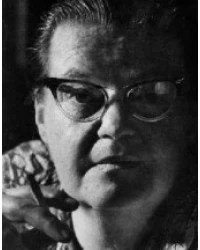
“The Maid Freed from the Gallows” performed by John Jacob Niles
Hangman, hangman, slack your line
Slack it just a while
‘Cause I think I see my papa comin’
Traveling many a mile
Traveling many a mile
Kelly:
Welcome to “Not in Her Own House,” season 2 of Reading Shirely Jackson: The Podcast. This season, join us as we explore the world of Jackson’s second novel, Hangsaman.
Kelly:
And we’re back!
Mckenzie:
Hi everybody! I feel like we should have the Kim Kardashian sound that’s like, “We’re back. Did you miss us?” in her robotic voice.
Kelly:
I have never heard that.
Mckenzie:
It’s from the new Kardashians on Hulu trailer.
Kelly:
I didn’t know that existed.
Mckenzie
Can you edit that in later?
Kelly:
Okay. We may get sued. No, you know what, that’ll hardly be the worst thing that ever happened to Kim Kardashian because of the internet. Do you want to tell the folks what we’re here for?
Mckenzie:
We’re here for the start of season two with a brand new name and a whole new attitude. Just kidding; it’s the same attitude. We have officially changed our name to Reading Shirley Jackson, or the Reading Shirley Jackson Podcast. Heart of the House will be the title of season one. And so each subsequent season will have its own title. But Reading Shirley Jackson will be our big title.
Kelly:
And Mckenzie, who’s in charge this season?
Mckenzie:
M-m-m-me! So we flipped things around this season. While Kelly remains our Shirley Jackson expert. I have read the entire book and will be talking us through the different parts of the book. And Kelly is going to be our first time reader.
Kelly:
What book?
Mckenzie:
Hangsaman
Kelly:
Yes.
Mckenzie:
We chose that for a couple of reasons. The first is that my research as I continue my dissertation reading is shifting towards a look at Gothic schools and the campus novel. And this is, of course, a campus novel.
Kelly:
Yeah, as I said, I’ve never read Hangsaman, I am not a Shirley Jackson expert. So this season, I will be the one who is reading in sequence, which is nice for me because it’s less work. But I will still be the one editing because I wouldn’t want anyone else to have to learn how to do that, because it is a huge pain.
Mckenzie:
Hangsaman has also been quite hot in the critical discussions of Shirley Jackson, which is pretty cool. It also, it is not officially set in Vermont, but it’s set in Vermont in my head. Kelly’s giving a look. She’s gonna refute that. But it’s set in Vermont in my head. I lived in Vermont for many years. So I’m excited to think about that as well.
Kelly:
I’m not going to refute that. I was going to point out that the place where you can read the latest publications on Hangsaman is the Journal of Shirley Jackson Studies. I know a couple of authors had some really great articles about Hangsaman in there. And in winter 2023, which probably means December or maybe November, December. I have an article coming out that’s about We Have Always Lived in the Castle.
Mckenzie:
Yay for Kelly!
Kelly:
So one of the things that I was reading a lot about is why so many people tend to think that Shirley Jackson’s work takes place in Vermont, even though to my knowledge, there is no story or novel that explicitly takes place in Vermont. The production of We Have Always Lived in the Castle that I’m writing about takes place in Vermont explicitly. And that’s one of the things that I think the book writer Hugh Wheeler did wrong. So keep an eye out.
Mckenzie:
Tell him—you should use the part of Knives Out where she’s like, you think that she’s saying “you did this” But she’s saying “Hugh did this.”
Kelly:
Like Hugh Crain?
Mckenzie:
No, like Hugh Wheeler.
Kelly:
Oh, yeah. Yeah. Sorry Hugh. So thank you very much. Actually, you know what, I’m glad that we brought this up, because it’s one of the things I’ve been nervous about. Hugh Wheeler. He’s in the ground now. But thank you for Sweeney Todd. Thank you for Night Music. Thank you for, I believe… I don’t remember but I know that you did Night Music. And I know that you did Sweeney Todd, thank you very much. We love you. Sorry, you’re dead, but you did a terrible job with the play.
Mckenzie:
So scaling back from Shirley Jackson for a bit. Kelly, how have you been? Besides your article? How is this semester going for you?
Kelly:
Well, it’s hard to think outside of that because it is due tomorrow. And it has been consuming my life for quite a while. Outside of that I am as I ever was. My very annoying downstairs neighbors moved out and I have to say: whenever I’m flagging, whenever I feel like giving up, I remember the sound of them learning that they were getting evicted, and, oh boy, that keeps me going. What about you?
Mckenzie:
So I have a new addition to my family. So Kelly… with the help of Kelly.
Unknown Speaker
That makes it sound like I was a surrogate.
Mckenzie:
I was just way too busy to be pregnant. So I hired my friend. No, we have a kitten who has entered our house, his name is Biscuit and he was actually living in Kelly’s parents’ backyard, and they decided that they wanted to give them homes. And so they went through all the trouble of trapping them, getting them spayed and neutered, and transporting them from the mean streets of Staten Island to Manchester, Connecticut.
Kelly:
Yes. So if at any point in any of these next few episodes, one of us screams, it’s likely because he brought out the death needles. And there’s also, of course, still Scout who’s upstairs crying, but Scout doesn’t like me. So we don’t let her down when we’re recording
Mckenzie:
Well, and I get intense anxiety whenever Biscuit and Scout get close to each other because I’m afraid Scott is going to eat him. Not that I actually think she is actually going to eat him, she just has a mean, mean, growl, you know what I mean? So she’s upstairs, I’m feeling guilty, though. I might bring her down.
Kelly:
If the people want to see pictures of the pets, where should they go?
Unknown Speaker
They should go to our brand new website,
Kelly:
readingshirleyjackson.com. I’m in the process of setting it up now. I’m very excited. I’ve never made a website before. And I have to say, it’s a lot harder than I thought it would be.
Mckenzie:
You’re glad you’re not in digital design programs.
Kelly:
No, you know, I was thinking about that. Because frankly, I’m somebody who talks a lot of shit about the digital humanities because it’s just not something that’s ever interested me. And I am fully aware that as I’m sitting there wanting to punch through my computer screen that maybe if I had taken some digital humanities courses, I wouldn’t be in this situation. But that is going to be our new home base on the web: readingshirleyjackson.com. You will also be able to access all our brand new shiny social medias there, as well as show notes and transcripts from this season as well as season one, which we will be adding very shortly.
Mckenzie:
The page numbers for today’s episode are pages 1 through 24 in the Penguin edition. There are no explicit content warnings for today. But I’ll give a blanket content warning for the season. This season will include discussions of sexual assault and mental health crises. We’ll give individual content warnings for each episode as well. But just please know that that’s going to be an integral part of our discussion this season. And so as always take the breaks you need. Take time away if you need or catch us next season or just re-listen to all those juicy Season One episodes and stick with us. No matter your comfort zone.
Kelly:
Next season, if we do The Sundial, I don’t think that there’s any content warnings needed there, although the end of the world
Mckenzie:
Who amongst us?
Kelly:
Well, that’s what The Sundial is about, my beloved Sundial. So before we get into the text of the novel today, I want to tell you guys a little bit about what the plan is. So one thing that we’re going to be really strict with ourselves about is we are going to be releasing episodes much more regularly than we did for season one. So episodes are going to be dropped every other Friday. So today is October 6, the next episode drop will occur then I believe, on October 20. And they will always drop on Fridays. So every other Friday, you will have a new episode from us. So it’s going to be another series of 10 episodes. And that’s going to take us through February. And we’re very excited. We may also have some special guests this season.
Mckenzie:
And I think what’s cool about this season is that when we started this podcast last year or the beginning of this year, we didn’t know what it was going to be. It started out as a project for our professional development class. It was really spearheaded by Kelly and I was along for the ride. And I think…I hope I can say for both of us, we found a lot of fulfillment and pleasure in just being able to talk about books and say stuff and laugh and you know, dive into texts without necessarily having to write 20 pages on them. We’ve also just been really grateful to anyone who’s listened, we got a couple of fan emails over the summer, which is something I at least had never even envisioned. I imagined it was just going out into the internet cosmere and we were gonna never hear from anybody. And so getting those messages has been really amazing and has us really excited to start season two, and really consider us a real podcast, at least for me.
Kelly:
Actually, on the note of contacting us. We do have a shiny new Gmail this season; you can reach us at ShirleyJacksonpodcast@gmail.com. And we will get back to you because as Mckenzie said, We love fan mail. So as always, you can reach us there with suggestions, questions. So do you want to tell the folks a little bit about what we’ll be talking about this season?
Mckenzie:
Yeah, so a lot of our themes for this season are really going to be continuations of our discussions of Hill House and then we’ll also get some new spheres we’re entering in. So as with every Shirley Jackson novel or story, home, or the idea of home is going to be really integral, which is especially interesting because the story starts at home, which if you’re reading along you’ll know, and spends actually quite a bit of time at home, and then transitions to Natalie going to college. So what does home mean for you, when you leave the home you know? How do you know when something is your home? Can you just decide? Or does it have to mean something? And how do you go about finding that? For Shirley, central to home is also the mother, as we learned from Hill House, but also the father, which really takes center stage in Hangsaman. The father character, I think, is quite funny. And so is the mother for that matter, so there’s this sinister comedy. With Hugh Crain, it was pretty plainly insidious.
Kelly:
There’s nothing funny about Hugh Crain.
Mckenzie:
I think him making a giant naked statue of himself is funny if you only think about it for a moment, but any greater investigation into that is, is really not funny at all. Whereas I think Mr. And Mrs. Waite, Natalie’s parents, have this really interesting blend of humor and darkness and the darkness of the regular. What does it mean to be a parent? What does it mean to be a child in a house that is not quite satisfied? And so that’s something we’ll be thinking about as well. New to the podcast, however, is going to be discussion of the coming of age novel, or the bildungsroman. So as Francine Prose notes in her introduction, Jackson in Hangsaman “reminds us of what it’s like to be 17 years old, developing an adult consciousness, and at the same time being explicitly even painfully aware of that development process.” Kelly, do you remember what it’s like being 17 years old developing an adult consciousness?
Kelly:
The only thing that I really really remember from being 17 is getting my wisdom teeth out. Oh, and in fact Shirley has a short story called “The Tooth” which I have also never read. But I know it was written right near Hangsaman.
Mckenzie:
Do other Jackson novels or Jackson stories center coming of age or are most of them like Hill House where they center adults? I mean, honestly, Eleanor also felt like a coming of age, but you know, at 32.
Kelly:
Richard Pascal calls Hill House a bildungsroman in reverse. So in fact, most of Shirley’s novels feature an actual adolescent, but it’s always an adolescent who doesn’t act their age. So The Sundial has Fancy who’s not really at the center, and she’s also a little bit younger, she’s maybe 10, or 12. And she is an absolute monster. We Have Always Lived in the Castle has Merricat who’s 18 years old, but acts about 12. Elizabeth of The Bird’s Nest, I believe, is in her 20s. But again, her psyche, we’re led to believe, splintered around the age of 12. Come Along With Me, that final novel, I know, that’s about a middle aged woman, and then The Road Through the Wall, which I have also never read. I think that there are probably some teen characters in there, because it’s about a whole town, The Road Through the Wall is by far the least studied of the novels. And I only just got a copy a few weeks ago.
Mckenzie:
Very exciting. I think we’ll look for how Natalie compares to Eleanor, I think there are a lot of crossovers. But I think Natalie is at this very specific moment in a young person’s life, that transition from home to college. And so we’ll think about what that means, what it means to grow up in Shirley Jackson’s world. And alongside of that, we’ll also think about the campus novel, right, again, one of the foci of my dissertation right now. And also just one of my favorite genres to read. So we’ll think about what makes a campus novel such a unique place for a story like this. And what makes that time between home and college so interesting, and then also what makes it uniquely haunted, right? You’re haunted by your past self, and you’re also haunted by what you thought college or life away from home is supposed to feel and is supposed to look like. Kelly, do you have any experiences with the campus novel?
Kelly:
I don’t think I do. I mean, aside from Harry Potter, I really don’t.
Mckenzie:
That’s exciting. So we’ll give a little bit of biographical and historical context before we jump in. But we’ll also as always have it sprinkled throughout, like last season.
Kelly was always really encouraging the reading of Ruth Franklin’s biography, and I have to wholeheartedly agree. I haven’t finished it yet, but it’s been really cool and integral to the planning of this episode. And also just really exciting to read biographical works. I was saying to Kelly, that in literary studies, it’s out of vogue to do any biographical reading at all, let alone research. So people are not interested in what Charles Dickens and his wife’s relationship was like if you’re looking at marriage in A Tale of Two Cities. And so I think it’s been really refreshing and cool to think about Shirley as a person and as the author of this text.
So, there are tons of details from Shirley’s own adolescence that mirror Natalie’s life. So for example, she has an easygoing, younger brother, just like Natalie. Her parents would throw these parties with their colleagues that Shirley would attend, just like we’ll see Natalie does. And she’s also in the process of honing her craft of writing, which we know that Shirley really began writing in earnest when she got to college, but had written her whole life. I have this quote from Ruth Franklin. “some writers are particularly prone to mythmaking. Shirley Jackson was one of them.” So thinking about how writing yourself into your characters is a mythmaking. And again, what do we do with that?
The other important historical context from Bennington College is really interesting. And again, I want to approach this with as much caution as possible. So often, when people summarize this novel, they’ll say it was based on the disappearance of a Bennington student, in 1946, named Paula Jean Welden. And that’s what the story is based on. We do not make that claim. And I think it’s important to say that there’s no evidence of that. So Ruth Franklin and her biography, notes that there’s no evidence that Paula Jean’s case influenced this book. That being said, Jackson was incredibly interested in the case, which it was hard not to be at the time, the whole town was totally obsessed with it. There were newspaper reportings on it for weeks. She was actually never found, she took a walk in Vermont along a long trail near Glastonbury Mountain one day and just never returned. It’s called the Bennington Circle, because three other people went missing on that exact trail. So two people before Paula Jean and one person afterwards, and all four of them were never found. So it’s just really horrible, creepy context that Shirley was writing in and we’ll trace that more, especially towards the end of the novel. And I think while it’s absolutely true, there is no basis or evidence for the fact that the novel is based on Paula Jean, I think it’s really difficult not to see echoes in the novel. And so we’ll trace that.
Again, Shirley did write a story explicitly about Paula Jean. And so the story “The Missing Girl” is actually the title is taken from one of the headlines that Shirley had collected on the case, she had a whole box of all the newspaper writings about Paula Jean Welden, we know she knew about it. We know she was interested, and we know she kept files on the case. And again, something I am really interested in is not just are there echoes of Paula Jean Welden but what is the literary impulse to say this was based on a real life girl that went missing and was never found? What does that say about text? What does that say about literature? What does that say about authorship? And what does that say about readership? That does feel really exciting to say this is based on a real life disappearance, and it was never solved. And we have this literary footprint of that occurrence. So, what does it say about us that we want to do that? You know, I don’t think it’s ultimately good or bad, but what is it?
And then finally, this is actually not the only novel that is said to be inspired by that case. So decades after Shirley lived in Bennington, Donna Tartt wrote The Secret History, which is honestly probably the most famous campus novel, I actually just reread it. And it’s really good. It’s very excellent. It’s very funny, and very well written. But it was also semi inspired by that disappearance. It details a very insular group of classic students on a fictional campus in Vermont called Hamden, who murdered their friend on a trail and we can presume that it is that trail. And so, again, we’ll be thinking about the campus novel, we’ll be thinking about real life inspirations. So again, the pages for today are 1-24 In the penguin edition. So first, I’ll just turn to Kelly. What was your first impression of this novel from an author you’ve read a lot of but your first time with this text?
Kelly:
So I don’t have all that much of an impression yet. I know this was pre Hill House. In fact, there were two novels between this and Hill House, it was this, then The Bird’s Nest, then Sundial, then Hill House, and so I think I’m reading this trying to think of it as a younger Shirley. I like it. It’s a lot funnier than I thought it was going to be, and more tedious than I thought it was going to be, and I will explain what I mean by that when we get to the end of the chapter.
Mckenzie:
Alright, so we begin Hangsaman with an epigraph “slack your rope Hangsaman/ Oh, Slack it for a while./ I think I see my true love coming/ coming many a mile.” Kelly, did you recognize this epigraph when you read it?
Kelly:
I don’t know where that is from but the “see my true love coming” is straight from Hill House.
Mckenzie:
Yeah. It’s very cool to see it actually, because this came first. So we’re thinking about, was she already thinking of that phrase, or did it emerge from some of these thoughts?
Kelly:
So just to be clear, we’re referencing in Hill House from Twelfth Night “trip no further pretty sweeting, journeys and in lovers meeting, stay and hear your true love’s coming.” I butchered that, but there’s a lot of true love.
Mckenzie:
It was pretty good, I thought. So this song comes from an old folk song that has actually a bunch of different names including “Gallus Pole,” “Gallows Pole,” “Hangman’s Tree”, “The Prickle Holly Bush,” but it’s called “The Maid Freed from the Gallows.” And there’s lots of different versions of it from lots of different places. But the general structure is that a young person, usually a young, unmarried woman, is about to be hung. And different people come and she asks them if they brought gold to pay off the Hang Man or the judge indifferent versions. Usually the father comes and he says, “No, I’m just here to watch.” The mother comes and she goes, “No, I’m just here to watch.” And then the true love comes and he has brought the gold and pays off the hangman
Kelly:
And she lives?
Mckenzie:
It’s either ambiguous or yes, she lives. There weren’t any versions that I found that had her dying at the end. And this is also where our intro song comes from. It’s “The Maid Freed From the Gallows” sung by John Jacob Niles. Kelly, first impressions to this being the epigraph?
Kelly:
So I don’t quite know how gallows are gonna fit in here except the Hanged Man tarot card. Are we gonna talk about that this episode?
Mckenzie:
Not this episode.
Kelly:
Okay. So we will get to the Tarot at some point, but yeah, I know that Shirley was really into Tarot, so I’m excited to see how it plays in.
Mckenzie:
So we’ll talk more throughout the season about how the epigraph fits in. But for now, we’ll jump right in. And I’ll ask Kelly to read the first few paragraphs of Hangsaman.
Kelly:
“Mr. Arnold Waite— husband, parent man of his word —invariably leaned back in his chair after his second cup of breakfast coffee and looked with some disbelief at his wife and two children. His chair was situated so that when he put his head back the sunlight, winter or summer ,touched his unfaded hair with an air at once angelic and indifferent —indifferent because ,like himself, it found belief not an essential factor to its continued existence. When Mr. Waite turned his head to regard his wife and children, the sunlight moved with him, broken into patterns on the table on the floor.
“Your God,” he customarily remarked to Mrs. Waite down the length of the breakfast table, “has seen fit to give us a glorious day.” Or, “Your God has seen fit to give us rain ,” or “snow” or “has seen fit to visit us with thunderstorms.” This ritual arose from an ill-advised remark made by Mrs. Waite when her daughter was three. Small Natalie had asked her mother what God was, and Mrs. Waite had replied that God made the world, the people in it and the weather; Mr Waite did not tend to let such remarks be forgotten.
“God,” Mr. Waite said this morning, and laughed. “I am god,” he added.
Mckenzie:
All right, what is this first little bit doing? What do you get from this first chunk?
Kelly:
So the first thing that jumped out at me is, like in Hill House, we start with a man who I assume as a secondary character. The other thing that jumps out at me is this is the most I’ve ever heard any of Shirley’s characters talk about God. And it’s interesting that God when He does appear is always connected with fathers. We’ve seen him in the form of Hugh Crain. And now we see a father figure quite literally saying, I am God.
Mckenzie:
It’s a little on the nose.
Kelly:
Yeah, so I like that we see the light touching him as sort of a halo. One thing that really strikes me about this first couple of pages that all these characters are always aware that they’re being looked at. And so he sits specifically so that when he puts his head back, the light touches him just the way he wants to, and it touches his “unfaded hair”, thank you very much.
Mckenzie:
So immediately we get a sense of Mr. Waite as somewhat vain, somewhat self important, and someone who has structured himself as the sun around which his family rotates. So we don’t actually meet Natalie proper until a couple paragraphs in. Jackson writes, “Natalie Waite, who was 17 years old but felt that she had been truly conscious only since she was about 15, lived in an odd corner of a world of sound and sight past the daily voices of her father and mother and their incomprehensible actions. For the past two years— since, in fact, she had turned around suddenly, one bright morning and seen from the corner of her eye a person called Natalie, existing, charted, inescapably located on a spot of ground, favored with sense and feet and a bright red sweater and most obscurely alive—she lived completely by herself, allowing not even her father access to the farther places of her mind. She visited strange countries, and the voices of their inhabitants were constantly in her ear; when her father spoke, he was accompanied by the sound of distant laughter, unheard probably by anyone except his daughter.”
So what is happening here? What construction of Natalie are we immediately getting?
Kelly:
Well, I was gonna say, straight out of Lacan because of the mirror, but it’s also straight out of Freud. So Natalie, it’s a very strange construction. She doesn’t remember existing before she saw herself in the mirror, of course, she’s got the bright red sweater, which is going to appear later on in Hill House and this is a very Eleanor paragraph, right? “I am here on this spot of ground. I exist.” And then we started throwing up the red flags. “Allowing not even her father access to the farthest places of her mind.”
Mckenzie:
Implying that the farthest access by any other person is her father. And then there’s that deeper version, but still her father at the center, in the most—has the most access to her so far. Did you feel like that, that you became a person at a certain age?
Kelly:
No, I was a person when I was born. And yes, I remember lots of things. My first memory is of being dropped in the fountain at the mall. I might have talked about that last season.
Mckenzie:
I don’t remember it.
Kelly:
So my aunt worked at Dress Barn in the mall. My parents took me to the mall, my mom was up in Dress Barn talking to my aunt, and my dad took me to throw coins in the fountain. I was probably about two. I remember I had pink corduroy suspenders on. And because I was very small, my throws did not reach the water. And so we went closer and closer and closer and closer, until finally he was holding me by my suspenders and I was throwing the coins and he dropped me. And into the water I went. He had to come sloshing in after me. And my favorite part of that story is that my dad says he watched all the other dads at the fountain look at him with horror, knowing that he was in so much trouble.
Mckenzie:
Oh my god.
Kelly:
I don’t remember falling in the water. But I do remember getting dried off and being very upset that I couldn’t wear my pink overalls ever again.
Mckenzie:
Oh, no.
Kelly:
That fountain’s not there anymore, but I’m still alive.
Mckenzie:
It’s there in your head.
Kelly:
Yeah, it lives in my heart.
Mckenzie:
But so the first thing we learn about Natalie is that she has this semi tenuous relationship with consciousness with selfhood. In fact, Susan Behrans notes that “Natalie Waite is indeed waiting” with the pun on the name, “for reality to come into focus to find her essential self” and that multitude of selves, or the blurriness of the self is going to be really important to this novel.
Kelly:
Can I just say, I don’t think that’s true at all.
Mckenzie:
Say more about that.
Kelly:
I don’t buy the Waite waiting thing. I just don’t, this character doesn’t seem to be waiting for much of anything to me.
Mckenzie:
Can you say more about that?
Kelly:
Yeah. So she doesn’t really seem to care about things. Whereas when we were dealing with Eleanor, she was constantly waiting for the day where she would get out. This character, it seems like all the others in her life are anticipating her leaving much more than she is; she’s just bobbing along. She didn’t even know she existed until she was 15. She isn’t waiting for anything. Sorry, Susan.
Mckenzie:
I think that’s interesting. I think I’m curious to see how you feel when she gets to college because I think there’s this sense of Natalie at home that feels maybe more concrete than her future self, but it’s something that we can continue to track
Kelly:
You’re a Royals fan. Do you know what they call Kate Middleton in college?
Mckenzie:
No
Kelly:
Wait-y Katie.
Mckenzie:
I did know that actually. Brutal. I have complicated feelings about Kate now though. So like Kelly said, we learned that the family is anticipating Natalie going off to college and to a college of her father’s choosing. And we also start to learn a bit more about how Natalie’s brain works. We get a little inkling of that in that passage where we’re thinking about the voices of the strange countries that she visits in her head, but we’ll get a real, a real good look into what that means. So as Natalie and her family are at the dinner table, we start to see a character who will come back again and again for Natalie, if not for the other characters in the novel. So Kelly, could you read us on page five? The section that starts “Natalie, fascinated?”
Kelly:
Natalie, fascinated, was listening to the secret voice which followed her. It was the police detective and he spoke sharply, incisively, through the gentle movement of her mother’s voice. “How,” he asked pointedly, “Miss Waite, how do you account for the gap in time between your visit to the rose garden and your discovery of the body?”
“I can’t tell,” Natalie said back to him in her mind, her lips not moving, her dropped eyes concealing from her family the terror she hid also from the detective. “I refuse to say,” she told him.
Mr. Waite spoke patiently. “You serve cocktails,” he said, “you’re always making them. With ordinary highballs everyone can make his own. They will anyway,” he added, driving home his point.
“I didn’t invite them,” Mrs. Waite said.
“I didn’t invite them,” Mr. Waite said.
“I called them,” Mrs. Waite said, “but you made out the list.”
“You realize,” the detective said silently, “that this discrepancy in time may have very serious consequences for you?”
“I realize,” Natalie said. Confess, she thought, if I confess I might go free.”
Mckenzie:
What is going on here?
Kelly:
So she’s got a movie detective in her head. I picture him as like, (old time detective voice) “the dame walked through my door”
Mckenzie:
(They laugh) Very much so.
Kelly:
Yeah, and she is imagining that she has murdered someone and is trying to cover it up. And you can probably already guess who that someone is. But if you can’t, we’re gonna get there in just a few pages.
Mckenzie:
I think that, “confess,” she thought, “if I confess I might go free” is really interesting and almost reeks of Eleanor to me; this thought that you’ve done something bad even if it’s something bad that’s not quite defined yet. This guilt that is living in you, which spurs up this detective figure.
Kelly:
And that if you confess that you did it, they’ll let you go. Which will not happen at all.
Mckenzie:
No, especially not with this detective. I think the way that the conversations are overlapping is interesting. Right? So Mrs. Waite saying “I didn’t invite them.” Mr. Waite saying “I didn’t invite them.” Mrs. Waite then says, “Well, I invited them but you made the list.” And then the detective talking about the discrepancy, right? There’s this mirroring of the conversation that’s going on in the background. I feel like I’ve done this, in my head where I’ve had little characters. Do you feel like you had that?
Kelly:
No. Also, I want to make clear for folks that they’re talking about Mr. Waite’s friends coming over. It’s Sunday, his academic colleagues are coming over to get tanked at a cocktail party. Maybe I’m just not an imaginative person. I don’t really have people who live in my head.
Mckenzie:
I feel like I especially at that age, I was much more in my own head. And so would have these kinds of conversations. So what’s interesting is that in Ruth Franklin biography, she talks about how this might have a semi autobiographical tilt to it or slant to it. She starts with actually a fact about Nathaniel Hawthorne, saying “Hawthorne is said to have developed an unusual quirk. He composed an inner dialogue divided into two personalities that substituted for conversation and companionship” because he was sickly. Oh, sorry. It’s really sad. I don’t know why I’m laughing.
Kelly:
He’s dead. You can laugh
Mckenzie:
“One side served as storyteller, the other as audience offering questions or criticisms.” And Franklin writes that as a teenager, Jackson did something similar, but on the page, she kept multiple diaries simultaneously, each with a different purpose.
Kelly:
I knew that
Mckenzie:
And so she had one diary, that was an All American girl who would write, “Oh, boy” a lot. And then she had a separate diary where she would write love letters to a boy named – Oh, his was Bud. And that’s the brother’s name, isn’t it?
Kelly:
Wow, that guy’s name is Bud Young, which is the blandest name you could possibly have. Bud.
Mckenzie:
That is unhinged, to name a brother character after a high school crush. That is unhinged, I think.
Kelly:
I think it’s perfect because it is the exact innocuous “some guy” name, like in The Bell Jar in the 50s. It’s Buddy, the guy that she’s expected to marry. In fact, before we started recording, we were saying, “What’s the brother’s name?” But also, I cannot let this go. What did the all American girl say in her diary?
Mckenzie:
I already said it. She says “Oh, boy.”
Kelly:
So “oh, boy,” for those of you who don’t know, which is everyone in the world: my cat Ruble has come to associate that phrase with dinner. Because I guess when I first got him, when I would get his food and bring it to his dish, I would say, “Oh boy!” so he learned that oh boy means dinner. So now that whenever he eats dinner, I have to say it and we refer to dinner in our house as eating Oh boy. And whenever anybody feeds him for me, they have to say it too. And the meanest thing, the coldest thing that I’ve ever heard in my life: our friend Marie Nour watched him while we were in, well, while I was in Ireland. And he was being bad one day and so she said she just gave him dinner in and didn’t say it and honestly it would never even occur to me to do that
Mckenzie:
Terrible. So oh boy, time even it’s a small innocuous thing in your life, is also related to Shirley Jackson.
Kelly:
I’m gonna think of that every time I say it now.
Mckenzie:
Another fact about Bud Young to whom Shirley would write a whole diary of love letters is that he played the oboe.
Kelly:
Oboe, oh boy!
Mckenzie:
I don’t know why that’s the funniest instrument. Oh. I think the oboe is the funniest instrument and also the least sexy instrument. Apologies to my friend Brenna who played the oboe, and I’m still good friends.
Kelly:
There are nerdier instruments than that, like the glockenspiel. Or the triangle.
Kelly:
I think the triangle… I think any percussion is cooler than any wind instrument.
Kelly:
No, not not at all.
Mckenzie:
Tell us your instrument hot takes.
Kelly:
I think the tuba is probably the least sexy instrument.
Mckenzie:
I think the tuba has a gravitas that the oboe cannot replicate. I think you have to be big to play the tuba, you know. So you have this… you’re this big person, this big instrument and you’re like, [tuba noise]I respect the tuba.
Kelly:
My dad played the trombone.
Mckenzie:
Trombone is perfectly, perfectly respectable.
Kelly:
He would be in the basement like wah wah wah wha wha
Mckenzie:
What is the sexiest symphonic orchestral instrument?
Kelly:
Oh, Jesus.
Mckenzie:
There is a correct answer.
Kelly:
The cello.
Mckenzie:
Yes. (they laugh), I think saxophone could emerge.
Kelly:
No, because I can’t think of that without thinking about Lisa Simpson or Bill Clinton.
Mckenzie:
So anyway, RIP, I assume, to Bud Young, oboe player and first love.
Kelly:
So they’re having this very sort of stilted conversation at breakfast. And I was saying earlier, how much visibility appears in this novel. All of these people are constantly aware that they’re under surveillance, particularly Natalie and her father. And so this is Mr. Waite about to get up from breakfast. “I could get some work done for a change. No one ever looks at anyone else in this house.”
Mckenzie:
And we do feel Shirley poking fun at academics and this again, just a faculty wife. It’s hard not to see that Mr. Waite is complaining about the party that he is forcing his wife to throw, saying, “I wish they weren’t coming.” Like Kelly, said, “I could get some work done for a change. Do you realize I’m two weeks behind in my work? I’ve got to review four books by Monday; four books no one in this house has read but myself. Then there’s the article on Robin Hood— that should have been finished three days ago. And my reading, and today’s paper, and yesterday’s. Not to mention,” Mr. Waite added ponderously, “Not to mention the book.”
at the mention of the book, his family glanced to him briefly in chorus, and then away, back to the less choleric plates and cups on the table.
Kelly:
I feel like he says the book and then there’s an old timey thunder clap.
Mckenzie:
And again, tragically for us a lot of those rings true for me. What about you?
Kelly:
Yes, the thing that sucks most about academia is you get so incredibly overwhelmed. And there is nothing that anybody can possibly help you with.
Mckenzie:
Yeah, and I think I’m an over scheduler. I have to keep working until my to do list is done. But I put 80 things on the to do list that can’t possibly happen in one day, so that I just work the whole night long and it’s not really good for anybody. But so we feel Shirley poking fun at this man who again, no offense to me, or to her husband or to Kelly, the article on Robin Hood is not going to save the world. It’s okay he’s not working on it.
Kelly:
Can we talk about his napkin ring?
Mckenzie:
Oh, yeah, go ahead.
Kelly:
Well, so I love this. “They all laughed and the sudden family gesture was so pleasant to them that they immediately took steps to separate themselves from one another. Mr. Waite left first; still laughing, he slid his napkin into the ring which was composed of two snakes curiously and obscenely entwined (“nothing to sit at a table with,” Mrs. Waite called it) and rose.
Mckenzie:
So it’s sexy snake.
Kelly:
What do you think is going on there?
Mckenzie:
Obscenely intertwined? Just like snakes fucking?
Kelly:
Yeah, do you know the Ouroboros?
Mckenzie:
No
Kelly:
A symbol of a snake eating its own tail.
Mckenzie:
Okay,
Kelly:
I don’t know what it entails. (laughs) So maybe we can look that up and put it in the show notes.
Mckenzie:
Funny enough. I’m in the middle of reading God of Small Things. And in that book, one of the main characters has a wedding ring that she melts down and turns into a snake ring. Funny synchronicity there.
Kelly:
And actually, there are snakes in We Have Always Lived in the Castle, which just popped into my head because I was editing that section today.
Mckenzie:
Very nice.
Kelly:
They don’t matter. They’re just there and Merricat kills them.
Mckenzie:
So as the family separates after this, it’s an awkward breakfast and then there’s a pleasant moment and that pleasant moment becomes awkward, and then they all disappear. Natalie goes out to the garden, which at least in this first part of the book will be a really significant place for her. So Kelly, could you read Natalie’s introduction to this garden?
Kelly:
“She did not really prefer the garden to several other spots in the world; she would rather, for instance, have been alone in her room with the with the door locked, or sitting on the grass by a brook at midnight, or, given an absolutely free choice, standing motionless against a pillar in a Greek temple, or on a tumbril in Paris or on a great lonely rock over the sea, but the garden was closest, and it pleased her father to see her wandering mornings among the roses.
‘And your age?’ said this detective. “Occupation? Sex?”
It was a beautiful morning, and the garden seemed to be enjoying it. The grass had exerted itself to be unusually green just beyond Natalie’s feet, the roses were heavy and sweet and suitable for giving to any number of lovers, the sky was blue and serene as though it had never known a tear.” And I have to say you could write an entire book about Shirley Jackson and grass.
Mckenzie:
Yeah, I thought that too. I especially thought about the picnic scene. Yeah, Hill House and how this nature that is not quite nature, but it’s also not quite human.
Kelly:
Yes.. And that’s how “The Lottery” begins. “The sun was shining and the grass was richly green.” Nature that’s so perfect that you know that something is very, very wrong here. We also get a little bit of hints of what Natalie’s writing is like. “The roses were heavy and sweet and suitable for giving to any number of lovers.” I’m gonna get really nasty when we talk about Natalie’s writing
Mckenzie:
I’m very excited. So while she’s in the garden, we are reintroduced to the detective as well. And again, I want to highlight Kelly’s comment about this obsession with visibility. The detective says, “What if I told you that you were seen?’
Natalie lifted her head, looking proudly off into the sky. “I have nothing to say,’ Natalie said barely able to form the words.
‘What becomes of your story now?’ the detective went on ruthlessly.” So there’s this obsession with visibility about being seen doing this crime, or doing something that she feels guilt about. Someone having always seen her in a way she doesn’t want to be viewed.
Kelly:
Or seen her at all. Because as she’s standing in the garden? Where is it? Oh, yeah, “it pleased her father to see her wandering mornings among the roses.”
Mckenzie:
Isn’t that gross?
Kelly:
Yeah
Mckenzie:
So like I said, the father figure or the paternal figure is really the center of this book in the same way that the mother was the center of Hill House in ways that are pretty icky.
Kelly:
So we’re eight pages in, people.
Mckenzie:
So Kelly, can you read Natalie and her father’s morning ritual on the top of page nine?
Kelly:
Okay, so she goes in to see her dad and she brings a notebook. “‘Come in, my dear,’ her father said.
He looked up, smiling at her across the desk as she came in.
‘Good morning, Natalie,’ he said formally, and Natalie said, ‘Good morning, Dad.’ It was a fiction of theirs that these little meetings began the day for both of them, although before meeting in the study, they usually breakfasted together, and pursued privately their personal morning occupations; Natalie watching the morning from her bedroom window and making hasty notes about it on her desk pad, combing her hair so that it fell carelessly along her shoulders, putting on the secret little locket she always wore; her father awakening and looking at himself in the mirror and smoking his first cigarette of the day, and presumably somehow dressing himself.” I love that. “Presumably somehow dressing himself.”
Mckenzie:
So what are we to infer from this section? What’s the relationship between Natalie and her father like?
Kelly:
She really cares what he thinks about how she looks. But at the same time, she wants to look like she doesn’t care. She combs her hair so that it falls carelessly along her shoulders. That is a perfect turn of phrase. Yeah, there’s nothing careless about Natalie’s appearance when it comes to her father.
Mckenzie:
And the whole thing is a facade, right? They’re saying good morning to each other, but they’ve already had breakfast together. It’s both fictions and the narratives we tell ourselves about our relationships, about our homes, and also a series of false starts. So that the day has already started, the novel has already started. And then this is like a second beginning or true beginning or a fake beginning, even. We eventually learned that Natalie has stayed up until 3am writing and that actually, her writing is encouraged by her father
Kelly:
Or mandated.
Mckenzie:
On the surface, encouraged. And this is actually different from Shirley’s own relationship with her family. In an interview with The New York Post in 1962, the interviewer asked, “You were encouraged to write by your family?”. And Jackson says
Together:
“They couldn’t stop me.”
Mckenzie:
Which is a pretty good line from Shirley. So we see a little bit of difference in those two things. There’s also some some nastiness about Mrs. Waite, Kelly, could you read that exchange? Starting with “this has always been a favorite of mine.” On page 10.
Kelly:
Yes, but before we get there, can I just point out that Natalie does not want children of her own?
Mckenzie:
Oh, yeah, very good.
Kelly:
She’s imagining herself, “she would be 34, and old. Married,probably. Perhaps — and the thought was nauseating — senselessly afflicted with children of her own.” The thing that jumped out at me there was the word afflicted. It’s either Hangsaman or The Bird’s Nest, I don’t remember perfectly off the top of my head, but one of those was written at the same time as Shirley was writing about the Salem Witch Trials, and she always used the phrase “the afflicted girls,” so a little bleeding over there.
“‘This has always been a favorite of mine, Natalie,’ he said stopping, at a page. ‘And the one on your mother.’ He chuckled and turned another page. ‘I hope she never sees it,’ he said and looked up at Natalie with a smile a child’s.
‘She’s never interested in my notebooks,’ Natalie said.
‘I know,’ said Mr. Waite. ‘Nor is she interested in my articles.’ He laughed and said, as though in compensation, ‘I never could have found anyone else so unsympathetic as your mother, and so helpful.’
This time Natalie laughed with certainty. It was a statement very true of her mother.
Mckenzie:
So this passage really reminded me, and this is maybe a cliche at this point, but the quote that’s like, “often father and daughter looked down on mother together, they exchange meaningful glances when she misses the point, they agree she is not as bright as they are, cannot reason as they do. This collusion does not save the daughter from the mother’s fate like that.” Oh, that passage always really made me sad. From Bonnie Burstow. I’ve heard it a lot on Tik Tok.
Kelly:
Oh, I never heard that.
Mckenzie:
And I think I honestly was like that when I was young. My dad and I…my mom was the smartest of us all. She was a very successful person. But one of the ways my dad and I bonded was teasing my mom in ways that were both normal and innocent, but also, sad in retrospect. And so I think that’s a really common experience of your dad mak[ing] you feel special at the expense of your mother. And so I think that was a very cutting section.
Kelly:
I just love “so unsympathetic as your mother, and so helpful.”
Mckenzie:
And this is happening as she’s planning and cooking a whole party. So this part is also very funny. So Natalie has written, we presume, something about her father, and he’s praising her writing and going through everything, giving little cuts as well. And so he stumbles upon a piece that presumably has him in it. And he goes, “‘Oh, no,’ her father said. ‘Not handsome, Natalie. That I absolutely disclaim.’
‘But it’s modified, Natalie said. She chose her words with mischief. ‘I particularly say that the handsomeness is largely arrogance; that so few people are really arrogant these days that such a person gives the impression of beauty. I liked that idea.’
Kelly:
(they laugh) One thing that — and I’ll use this phrase which I said last week — gets my goat about Jackson scholarship is I feel like there’s this tendency whenever Shirley’s being mean to a man, (and we were guilty of this in our Dr. Montague episode,) whenever Shirley is being mean to a man, we assume it’s Stanley. And so earlier in the text here, it say, “The books on the walls had been read, although not necessarily by Mr. Waite.” And so there’s this assumption that yes, we’re lampooning academics. We’re lampooning Stanley, but think we’re moving away from Stanley land here.
Mckenzie:
Really? Okay. You think it’s a fictional father or more her father?
Kelly:
Oh I don’t really know all that much about Shirley’s father, although one thing that I want us to keep thinking about as we move forward as he was from England. And that was something that I think probably does more for the writing than we’ve previously thought. Hangsaman’s origins are very English. We’ll talk more about that later.
Kelly:
So he continues to think about her writing and again, gives these little digs as well. “I’m interested in seeing you write whatever you please, and in encouraging you to write more. But you must, if you are ever to be a good writer, understand your own motives.’” Kelly, can you read what he says about himself on page 13?
Kelly:
This is in Forrest Gump voice to me. (Forrest Gump voice) “‘I am not a vain man,’ he began slowly, ‘I do not hold myself in undue estimation. As a matter of fact, my own description of myself would be much harsher than yours. You do not mention my pettiness for example, although you hint at it in your statements about’ — he consulted the notebook — ‘the fact that I substitute words for actions. You overlook one of my outstanding characteristics, which is a brutal honesty which frequently leads me into trouble– an honesty so sincere, that applied to myself, it gives me a picture I cannot be proud of, although you name me as a proud man. My honest picture of myself has led me to aim less high than many of my contemporaries, because I know my own failings, and as a result I am in many respects less successful in a worldly sense. They, without knowledge of their own shortcomings, were able to conquer blindly while I, always hesitating through doubt of myself, lost my chances and fell. You do not mention—and I am using the same brutal honesty on myself now— that I am not always so kind to my family as I should care to be, because I am perhaps too much concerned with my own emotions at the expensive of theirs— although, to speak with bitter truth, I am a person not gifted with great emotions and consequently, while I can never be sentimental, I can never be great.’”
Mckenzie:
So is this purely a dismissive or scornful picture? Or is there some…? What is this character she’s creating?
Kelly:
The word I wrote down was ‘bloviating.’ Yeah, it’s a bunch of crap. It’s nothing. One thing that Shirley likes to do a lot is have characters go on and on and on, and have what they’re saying mean absolutely nothing. I think that’s what she’s doing.
Mckenzie:
So there’s zero charity in someone being like, “I know I’m not a genius.”
Kelly:
Oh, yeah. No, he thinks he’s a genius. No, he’s saying that because he wants her to be like, “Noooooo!”
Mckenzie:
He did say he was God on the first page.
Kelly:
Are we going to talk about what she’s imagining happening in the office?
Mckenzie:
Yeah, go ahead.
Kelly:
So she’s imagining (this is on page 12), “She would be found at the desk, not five feet away from the corpse, leaning one hand on the corner to support herself, her face white and distorted with screaming. She would be unable to account for the blood on her hands,” blah, blah, blah, blah, blah. So she’s imagining that she’s basically killed her father?
Mckenzie:
Yeah. Do you think that this is genuine feelings of violence towards the Father? Or do you think this is just, deep, deep, deep inside somebody’s consciousness?
Kelly:
I don’t know. There is a tendency in Shirley’s work toward family annihilation, literally killing your family. In The Sundial, there is a family annihilator. I think her name is Harriet Stuart, based very clearly on Lizzie Borden. So this idea of just chopping up your family, or in this case, shooting your father, super common in the works of Shirley Jackson.
Mckenzie:
And then we get through the detective, an alternative male trope, right. So if we have the father as the corpse, then this other male dominating figure arises in her consciousness to interrogate her. So again, we’re going to keep tracking the paternal and what that looks like, in this novel,
Kelly:
(old timey detective voice) “You had to shoot him, see?” That’s what this detective sounds like in my head.
Mckenzie:
So now we get even, even grosser, perhaps. This is on page 14. “‘Natalie,’ he said solemnly, ‘you know by now that it is natural for girls to hate their fathers at some point in their growth. Now I submit that at this time of your life you are growing to hate me.’” And Natalie’s like, “No. No, I don’t”. And he goes on, “When you were born, and when Bud was born, I realized, even though your mother did not, that there would come a time when you would both rebel against, us hating us for what we’ve represented, fighting to get free of us; it’s a reaction so natural that I am ashamed to think that now I have a pang, a twinge when I recognize it at last…This is your stage now.” So as Natalie and her father wrap up their conversation about her writing, that is actually just about her father, he asks if she’s coming to the party this afternoon. And Kelly, what does he tell her?
Kelly:
“‘Try to help your mother if you can. Entertaining is difficult for her. A fundamental hatred of people, I believe.’” Before we leave Natalie and her father, I just want to point out he when he’s talking about, “I know you’re gonna hate me.”, “it only means that we must recognize now that you’re a growing girl and I an old man, and that a basic sex antagonism, combined with a filial resentment, separates us so that we cannot always be honest with one another as we have been up to now.’” This makes me feel like Hugh Crain’s book: the sequel. Even though this was written before Hill House. So he’s talking about how, oh, you know, we used to be joined. And now we have to be separated because of sex antagonism, which is a normal thing for a father to say.
Mckenzie:
And so we’re seeing the echoes of like you said, of what Hugh Crain will become and I’, imagining Hugh Crain doing this with his daughters, being like, “I am God, what did you produce for me today?” And then trying to immortalize the time before she grew up.
Kelly:
Which Natalie cannot remember at all. I don’t want to…
Mckenzie:
I don’t think yeah, I don’t think that’s what’s happening. Yeah, but I do think their relationship is not healthy. We’ll see later in the letters that they write to each other when Natalie is at college. They always start with the signifier, my so my child, Natalie, my dear my daughter, my little daughter, daughter, mine, and then one says, “My dear captive Princess.”
Kelly:
Oh boy
Mckenzie:
Which we’ll have to talk about. But so there’s this ownership over the daughter. that actually doesn’t seem to transfer to the son.
Kelly:
Oh, yeah. He doesn’t care about his son.
Mckenzie:
Yeah. It’s hard to tell how much of Natalie’s perspective is dominating the narrative.
Kelly:
Well, he cares very much that his son is not coming to the party, because, “‘You will be at the party this afternoon?’ he asked, accenting the you just enough to make Natalie remember Bud’s refusal to come. So he’s doing it in the guilt way, like your brother turned me down. But you’ll be there right?
Mckenzie:
Yeah, Natalie is clearly both desperate for his approval. So he’s succeeding and the way he wants to be framed with Natalie, and also interested in the stuff that he’s interested in, poetry and writing. And so it might just be convenient that Natalie wants to impress him, and so he’s like, “Okay, this is the child that I will swoop under my wing”, or that he’s genuinely just more interested in her than her brother
Kelly:
Yeah, her brother is getting the hell out of there.
Mckenzie:
And again, has a very good natured attitude, compared to Natalie. So again, we follow the Waites as they are preparing for this party on Sundays. We learned that this is a weekly occurrence, that Mr Waite is always having people over on Sundays and expecting Mrs. Waite to provide, quote, “various manner of refreshments for Mr. Waite’s casual guests”. And we’ll also see —this isn’t a spoiler— when the party happens. It’s random people that he’s like, “Come on over on Sunday.”” And so he never really knows who’s gonna show up. It’s just this assortment of vague acquaintances. Yes, that again, he’s making his wife do all this stuff for him after insulting her to his daughter.
Kelly:
I love this: “what Mr. Waite confidently referred to as a potluck, although it was Mrs. Waite who dealt with the pot.”
Mckenzie:
That’s really funny. So again, I think there’s some… compassion is too strong a word. I don’t think Shirley is totally making Mr. Waite an empty shell. But I do think she wants us to understand his failings. But Natalie is helping her mother prepare.
Kelly:
“The kitchen was, in fact, the only place in the house that Mrs. Waite possessed utterly; even her bedroom was not her own, siince her husband magnanimously insisted upon sharing it. He shared also the dinner table and the services of the radio in the living room; he felt himself privileged to sit on the porch and to use a bathtub. In the kitchen. However, Mr. Waite amusingly confessed himself ‘ inadequate’, and so Mrs. Waite one day a week was allowed a length of time unmoleste, except for the company of her daughter.”
Mckenzie:
So again, there’s a very important spatial organization in the house. We can think about the kitchen that we saw in Hill House and how that was Mrs. Dudley’s domain. Although she’s not really a mother figure. It’s interesting to see the kitchen as this squared away space
Kelly:
And an expressly female space. She makes the kitchen like room with a sign saying “Ladies Only” on the door
Mckenzie:
I thought that was sweet. Could you keep reading to the end of that paragraph?
Kelly:
“Perhaps, even ,Mrs. Waite felt that in these hours that they shared the kitchen, she and Natalie were associated in some sort of mother-daughter relationship that might communicate womanly knowledge from one to the other, that might, by means of a small female catchword or female innuendo, separate, at least for a time the family into women against men. At any rate that kitchen alone with Natalie was the only place where Mrs. Waite talked at all, and probably because she talks so little elsewhere she made her conversation in the kitchen into a sort of weekly chant, a news bulletin wherein all that Mrs. Waite had thought or wanted to say or felt or surmised during the week was aired and considered, in combination with Mrs. Waite’s refrain of reminiscence and complaint. Natalie admired her mother at these times, and, although she would go to any lengths to avoid even the slightest conversation with her mother in the living room, she enjoyed and profited by the kitchen conversations more than even Mrs. Waite suspected.” We do not have a small child held captive. That is the noise of Scout scratching at the bedroom door.
Mckenzie:
Kelly, how would you describe the relationship between Natalie and Mrs Waite in this paragraph?
Kelly:
So I’m glad you brought up Mrs. Dudley before because my impression with Mrs. Waite suddenly bursting out with all this speech is this what Mrs. Dudley does when Mrs. Montague is finally in the kitchen with her. This scene makes that scene in Hill House makes sense for me, this woman who has kept it down kept it down kept it down kept it down and then all of a sudden explodes, but the things she explodes over are really inane. She talks an awful lot, but is she saying anything?
Mckenzie:
Do you have any knowledge about Shirley’s relationship with her own mother?
Kelly:
Yes I do.
Mckenzie:
Any of that you’re seeing here?
Kelly:
I don’t know what they were like when they were in the room together. I know her mom was awfully mean about her weight. Towards the end of her life when she published We Have Always Lived in the Castle, she had a new author photo, and Geraldine wrote her and said, “I can’t believe you allow yourself to look like that”.
Mckenzie:
Aww. And I think that’s their relationship through Shirley’s adolescence as well. In the Franklin biography, Franklin discusses how Geraldine, Shirley’s mother, got pregnant as soon as she got married and was a socialite and wanted a socialite lifestyle and Shirley wasn’t the daughter that she expected or wanted, so once Barry,her younger brother, came into the picture it was really clear that he was the favorite. And with Shirley’s focus on home and motherhood, this is one of many depictions of troubled mother daughter relationships. So Mrs. Waite while they’re in the kitchen is talking about her own childhood and how she was raised and eventually starts talking about her relationship, her own parents’ relationship and eventually also starts talking about her relationship.
“‘I always used to wonder how people made happy marriages and made them last all day long. every day. Seemed to me my mother wasn’t happy but then of course I didn’t know. Natalie, see that your marriage is happy,’ She turned and looked earnestly at Natalie, the knife resting against her palm. ‘See that your marriage is happy, child. Don’t ever let your husband know what you’re thinking or doing, that’s the way. My mother could have done anything, anything she wanted, my father would have let her, even though probably he wouldn’t have known. Of course, by the time he died, she was too old.’”
Kelly:
Okay. So this is Mrs. Waite’s Guide to Life. Her cardinal rule: never let your husband know what you’re thinking ever and everything’s gonna be fine. Now I want to point out Mrs. Waite’s name.
Do you remember what it is?
Mckenzie:
No, actually
Kelly:
Charity.
Mckenzie:
Oh, Jesus.
Kelly:
And she’s aware of that. She says, “My father knew what he was doing.” So she’s making this dinner that I think Shirley describes really beautifully. She says, “her Sunday casserole, which, incredibly complex and delicate, would be devoured drunkenly in a few hours by inconsiderate and uncomplimentary people.” So as she’s talking to Natalie, she’s slicing the meat beautifully thin with her butcher knife. So Mrs. Waite is sort of an artist in her own right. And then just a bunch of drunk academics come and just demolish
Mckenzie:
It’s almost Shirley being charitable to mothers that everyone assumes are vapid. Right, this idea, don’t ever let your husband know what you’re thinking, the idea that any mother that anyone has made a quick judgment about actually could have this rich inner life. You just don’t have access to it because she has not granted that to you. And then to echo what Kelly’s saying, the artistry involved in making a dinner that then gets devoured. I was telling Kelly, I’ve been very obsessed with Julia Child lately. There’s a Julia Child cooking show where they recreate meals that Julia Child made. There’s the HBO show.
Kelly:
Are they also visibly drunk?
Mckenzie:
No, they are not, how dare you. And there’s the TV show about Julia Child that’s really, really good. And then there’s the documentary on HBO. It’s a little set and I watched all of it. And just to bring it back, Julia Child actually met Shirley, and said she was lovely and warm and talented. But the show—and I’m sure this was a quote from Julia Child— asked this really interesting question about cooking and about food and can it be art in the same way that something like literature or the fine arts can be if it is destroyed every time? And I thought that was really beautiful. The ephemerality of food, and that it’s still beautiful, even if it can only exist for an hour.
Kelly:
Eating ,cooking, food, are all over the work of Shirley Jackson. And it’s one of those things that once it has been seen, it cannot be unseen. And I really wasn’t aware of it until I came across an article in Kristopher Woofter’s Shirley Jackson: A Companion, which was published in 2021, which is really wonderful, and everybody should read it. The name of the author is escaping me now, but there’s an entire article about Shirley and food. So yeah, it’s really interesting. And if you compare that to the Roald Dahl story, “Lamb to the Slaughter,” have you read that?
Mckenzie:
No, can you tell us about it?
Kelly:
Roald Dahl of Matilda fame, also raging bigot. He wrote a story that I read in high school about a woman whose husband tells her he’s leaving her. She’s a Mrs. Waite, she’s very prim. She’s a housewife. And in revenge, she kills him with a frozen lamb shank. And then she cooks the lamb shank and when the police come to investigate the murder, she serves it to them. And the story ends with them eating the evidence saying, “Oh, the evidence is probably right under our noses, boys. This is delicious lamb.” So very much the same thing.
Mckenzie:
Speaking of evidence, we get a resurgence from our detective friend. He’s continuing to ask Natalie about her crime. And then Kelly can you read the final exchange between Natalie and Mrs. Waite, this is on page 20.
Kelly:
“‘Natalie,’” Mrs. Waite said, her hands quiet for a minute while she stared at the wall before her. “What will I do when you’re gone?”
Embarrassed, Natalie carefully turned the flame down under the boiling eggs. “I’ll be back a lot,” she said inadequately.
“A mother gets very lonesome without her daughter,” Mrs. Waite said, “especially when it’s an only daughter. A mother gets lonsomer than anything in the world.”
One of the things which Natalie most disliked about her mother was Mrs. Waite’s invariable trick of putting serious statements into language that Natalie classified as cute. Mrs. Waite, too long accustomed to seeing her most heartfelt emotions exposed, discussed and ignored, had long since fallen into protecting herself by stating them as jokes with an air of girlish whimsy, which irritated both Natalie and Mr. Waite as no flat statement of hatred could have. Because of this; Natalie — who had sometimes thought of running to her mother with a voluntary expression of affection — said briefly, ‘You’ll find something to do.’
Mrs. Waite was silent. She had set the casserole carefully into the oven and turned her attention to the silverware before she began again very timidly, ‘and at home when we had no dishes for all those people we used to ask one of the aunts to bring along…”
Mckenzie:
Very sad. And so we see Mr Waite reaching out to Natalie and also…you think no?
Kelly:
Say what you’re thinking then I’ll [go].
Mckenzie:
I thought it was really heartfelt. Mrs. Waite, trying to connect with Natalie over this shared time they had. Do you think it’s more sinister?
Kelly:
I don’t think it’s sinister at all. I just have less sympathy for her. “A mother gets very lonesome without her daughter. A mother gets lonsomer than anything in the world.” That’s putting an awful lot on Natalie.
Mckenzie:
That’s a good point.
Kelly:
I think she’s really turning on the guilt there.
Mckenzie:
Yeah, but I think that we’ve seen… I think it’s purposely put that we’ve already seen the disdain that Natalie and her father have for her mother. And l this paragraph about “she was too accustomed to seeing her most heartfelt emotions exposed, discussed and ignored.” So she’s putting on this air of cutesy Hallmark pillow to have a shield between this truest thing of, “I feel so alone, and the daughter that is supposed to be connected to me is leaving.”
Kelly:
Write to us. shirleyjacksonpodcast@gmail.com. Tell us how much sympathy you have for Mrs. Waite.
Mckenzie:
So 1 to 10 how much sympathy do you have for Mrs Waite?
Kelly:
Six
Mckenzie:
Oh, that’s actually higher than I thought.
Kelly:
What did you think I was gonna say?
Mckenzie:
I don’t know. But I’m saying seven. Okay. I think it’s funny we had a debate about it.
Kelly:
The other thing I want to point out is something that I’ve been thinking about a lot lately, which is just how brilliant Shirley is at dialogue. So Natalie’s mother, much like Natalie’s father, is just monologuing. “‘Anyway, I always remember that uncle sitting in that chair. I guess all young girls— more water there, Natalie— get to hate where they’re living because they think a husband will be better. What happens is that a husband’s the same, usually. When I met your father he had a lot of books that he said he read and he gave me a Mexican silver bracelet instead of an engagement ring” and on and on and on and on. So this I guess “all young girls [interruption] — more water there, Natalie— get to hate where they’re living. Which is so true to how people speak. I just love that.
Mckenzie:
And I mean, to be fair, to your point about Mrs. Waite, she is rehearsing her own existence by making Natalie help her in the kitchen and not Bud.
Kelly:
Didn’t he leave though?
Mckenzie:
Yeah, but I mean, she could have been like, “No, you’re gonna stay and help.” He’s still a child. Not that that is all her fault. Things are institutional and systemic. But I do think that’s interesting as well that she’s talking about the shallowness and the deception of this life while also training her daughter to take it up.
Kelly:
And she does not anticipate at all that Natalie’s life could be different. “It’s going to suck. Get used to it.” Natalie said something earlier that reminded me of what Mrs. Waite is talking about here. So this is on page four. “Natalie was desperately afraid of going away to college, even the college is only 30 miles away that her father chose for her. She had two consolations: First, the conviction from previous experience that any place might become home after awhile, so that she might assume with reasonable probability that after a month or so the college would be familiar and her home faintly alien.” So Natalie’s construction of home is just “You’re put there and you stay there for a while. If you do that long enough. It’s going to be home”. Mrs. Waite says “you get to hate where you’re living. You get to hate home because they think a husband will be better. Actually, it’s just the same.”
Mckenzie:
We will see that a lot too when Natalie actually gets to college, these meditations on home and the perspective of home as well. So she writes this really interesting letter to her father where she’s like, I can’t describe where I’m at. Because at this point, it’s familiar to me and you will only know it as that place you were at to drop me off. How space is actually different to different people, which is obvious, but I think Shirley writes about it in a really interesting way. Okay. All right.
Kelly:
You ready to bring it on home?
Mckenzie:
Yeah, so we have a scene of Mr. and Mrs. Waite bickering again. And I want to highlight one thing that happens in the midst of that bickering, Natalie starts imagining what she calls future excavators finding the remains of Natalie and her home and her family. Shirley is being sarcastic in many ways and tongue in cheek but I actually think this part is really beautiful. And these are the fake anthropologist talking “‘And see,’ another voice called from the end of the kitchen. ‘See here, these very strange objects. Ornaments, I’d judge. And look here, at these two skeletons here. See, look here. They had children.” I think there’s actually probably a much more sinister reading where it’s like, children, leave wounds on your body. But I think the idea that your life can be told, I think that’s a really poignant and and fascinating motif.
Kelly:
I read that very differently.
Mckenzie:
Tell me
Kelly:
So Natalie earlier in the text is talking about how she has a cavity and she doesn’t want to let her mother know. She imagines that the excavator pick up her head “holding her precious head in his hands, turning it over and examining intimately, might remark, ‘Look here at these teeth; they knew something of dentistry, at any rate.” So we know that he’s holding Natalie’s skull. Then something really weird happens. “‘Here’s one filled with gold, it appears. Had they any knowledge of gold, do you remember? Male, I should say from the frontal development.’” So are they still talking about Natalie’s skull?
Mckenzie:
I think they’re finding the remains of the whole family.
Kelly:
But then they would be talking about Natalie separately from children because they already picked up Natalie. “See here they have children.”
Mckenzie:
I think children from their bones. Like the birth canal.
Kelly:
No, they say “‘Look here. Look at these two skeletons here.’” I think those are the skeletons of the children they had
Mckenzie:
I think we’re just interpreting it differently. I think I’m saying they would look at the skeleton and they can tell who gives birth from the skeleton. Again, this idea of the wounds left by the child. Even bones know, the pain of birth, the agony of procreation.
Kelly:
But you would never know that from talking to Mrs. Waite. Check back with me in episode 10 In February because I don’t think I’m gonna love any line in this novel more than Mr. Waite saying “I don’t think I could have found anyone less sympathetic or more helpful.” Okay.
Mckenzie:
Okay. That’s your favorite line.
Kelly:
This is not Mrs. Natalie. Essentially, that’s what she is. She’s Mrs. Natalie. She is on top of things. Natalie: “Standing at the kitchen table next to her father, Natalie looked peacefully at the scene of competence around her.”
Mckenzie:
That’s a good one. So our last big section for today focuses again on the garden. So Kelly, can you read us that paragraph where Natalie describes her relationship to the garden?
Kelly:
“The garden belonged exclusively to Natalie; the rest of the family used it of course, but only Natalie regarded it as a functioning part of her personality, and she felt that she was refreshed by 10 minutes in the garden between the arbitrary pleasures assigned to her by other people. If she sat on the grass at the foot of the lawn, her back against a tree, she could look out over fields that seemed soft at this distance, into mountains far away, since her father had sensibly enough chosen a picturesque location in preference to her mother’s choice of something that might grow something; thus, at the back of the house, there was a kitchen garden ineffectually tended by Mrs. Waite, which yielded a regular crop of dubious radishes and pallid carrots, and the rest of the lands about the house — some three acres of it— was allowed to run to meadow, or vacant lot standards. Natalie’s garden was in front of the house, and was tended by a gardener who refused to touch the kitchen garden, and this part of the property ended uncertainly in a sort of cliff —if you looked at it from far enough back— below which ran south road. Behind the house, behind even the kitchen garden, Mr. Waite had graciously permitted trees to grow unmolested.” That’s the second time we’ve seen the word unmolested, both in relationship to Mr. Waite. “Unmolested, and when Natalie was younger, before the garden and the view from the cliff had taken such a hold of her, she had delighted in playing pirate and cowboy and knight in armor among the trees. Now, however, for some reason only remotely connected with knights in armor, the trees on the grass belong to her and she ignored the trees below as dark and silent and unprovocative”
Mckenzie:
Anything here jumping out to you?
Kelly:
Since I’ve been working with We Have Always Lived in the Castle, one of the other things that Hugh Wheeler did wrong in the play, which I am here to tell you about, is that he removed Merricat and Constance from nature. And that’s a problem particularly for Constance because she loves her garden. And so I see a proto Constance here. Constance would be one of the last characters Jackson created.
Mckenzie:
Very cool. I’m also struck even more by that line of Mr. Waite enjoyed seeing Natalie in the garden. So how much of this is in that perspective or frame of mind? Because in the earlier garden scene, isn’t she like, “I didn’t even like the garden that much” or “the garden wasn’t exclusively mine”?
Kelly:
I thought she was in the other garden before.
Mckenzie:
Oh, okay, that makes sense. Then, I thought it was a rewriting of that experience. What it meant to her in relationship to her father, so that makes a lot more sense. Yeah,
Kelly:
Here it says this garden belongs exclusively to Natalie, and it is a functioning part of her personality.
Mckenzie:
Because she says earlier, she did not really prefer the garden to several other spots in the world.
Mckenzie:
Yeah, I think that’s the other garden.
Kelly:
So what does Natalie like to do in her garden?
Mckenzie:
Kelly, why don’t you tell us because I know you’re particularly interested.
Kelly:
This is the top of page 23. “The sight of the mountains far away was sometimes so perfectly comprehensible to Natalie that she forced tears into her eyes, or lay on the grass, unable after a point to absorb it— she was, of course, adequately hidden from the windows of the house.” Two things here: she cannot be seen in the front garden, whereas she knows she can be seen in the back garden, but she forces the tears to her eyes. “But there was a point in Natalie, only dimly realized by herself, and probably entirely a function of her age, where obedience ended and control began; after this point was reached and passed, Natalie became a solitary functioning individual, capable of ascertaining her own believable possibilities. Sometimes, with a vast aching heartbreak, the great, badly contained intentions of creation, the poignant searching longings of adolescence overwhelmed her, and shocked by her own capacity for creation, she held herself tight and unyielding, crying out silently, something that might only be phrased as, “Let me create. Let me create.” That’s not Shirley. That is Natalie thinking the way she writes. Did you pick up on that?
Mckenzie:
I didn’t, but I know you have. Do you think she’s good, Kelly?
Kelly:
No, no, I don’t. This is Natalie trying to sound like Virginia Woolf. Writing at the bottom of the page, I wrote down “Halloran bullshit.” The Hallorans have lots of phrases on their grottoes, on the walls in the house, and they say things like “fear no more in the heat of the sun” And “man does not live on bread alone.” And I think it’s Daryl Hattenhauer who says that it’s all white noise. It doesn’t mean anything. And so Natalie, her writing, I’m sorry, Natalie. It’s so effulgent, effervescent, and overflowing, which is not at all how Shirley writes. We’ve seen that Shirley is very restrained. And so it seems to me here that Shirley is really letting herself off the leash and trying to write the way a 17 year old would. And frankly, that was how I wrote when I was 17.
Mckenzie:
Yeah, I do think it’s a warm depiction, even though Shirley is making fun of her. I agree. But if you look at the next paragraph, she writes, “If such a feeling had any meaning to her, it was as the poetic impulse which led her into such embarrassing compositions as were hidden in her desk. The gap between the poetry she wrote and the poetry she contained was for Natalie something unsolvable.” So I think l Natalie is reckoning with the fact that what she writes is embarrassing. The feeling she has when she’s alone in her garden, is pure and is special. You know what I mean?
Kelly:
But she forces tears into her eyes.
Mckenzie:
I think that’s not her being disingenuous. It’s the genuine longing of a teenager to feel something substantial, which on its own is, I think, meaningful. I think the desire to create an experience meaning is on its own meaning.
Kelly:
I have a friend who actually was my professor who really hates Jane Eyre, and not a fan of the Gothic. And the way she describes the Gothic is the characters are always like, AHHHHHHHHH. Shirley’s characters really are not. But Natalie is very AHHHHHHHH here, would you agree? You can’t see what I’m doing with my hands but I’m reaching and clawing at the air
Mckenzie:
I find it so relatable, I think Shirley is being very honest about what 17 means, what adulthood means, especially at the brink of adulthood. For somebody who wants to lead an extraordinary or creative life? I think there’s a specific urge that is false, but then it’s also semi universal.
Kelly:
I’m gonna get flamed for this, because I am not being very kind to Natalie. I don’t know what she wants. I don’t know what she cares about. I don’t think she really wants anything.
Mckenzie:
You don’t think she actually cares about writing?
Kelly:
No.
Mckenzie:
Interesting.
Kelly:
I think she does it to please her father. Name one time in these pages where she expresses wanting something
Mckenzie:
Right here. I think “the gap between the poetry she wrote and the poetry she contained was for Natalie something unsolvable.”
Kelly:
That to me, is, as Darrell Hattonhauer would say, white noise. She is thinking that and thinking to herself, “wow, what a beautiful thing I just thought.” To me, it seems Natalie is very much playing the part of the longing, poetic woman.
Mckenzie:
I think you can play that part and have it still be true.
Kelly:
I don’t know. I have less patience for Natalie than I have for Eleanor.
Mckenzie:
I know. I was thinking that the first episode of season one I was pretty harsh on Eleanor. And so I’m curious to see how it evolves from here. Okay, so we have our last section. Do you want to just skip to the last paragraph or do you want to do the full mountain thing?
Kelly:
I don’t want to do the full mountain thing but I do want to point out one thing. I’m going to count how many times I mentioned The Sundial in these pages and then at the end of the season, I will do one shot per time and I think this episode alone I would probably die. Here’s our last Sundial for the day. So Natalie is getting very pastoral imagining the world. “Her feet brushed the ground– she could feel it, she could feel it —her hair fell soundlessly behind, her long legs arched, and the breath came cold in her throat. The first to awaken, the first to come, misty into the world, moving through an unpeopled country without a footstep, going up the mountains, touching the still wet grass with her hands.” The Sundial is all about being the first people in the new world. Of course, the joke of The Sundial is that these are the worst possible people to start a new world. Do you want me to read the last paragraph?
Mckenzie:
Yeah, do it.
Kelly:
“The mountains, full bosomed and rich, extended themselves to her and a surge of emotion, turning silently as she came, receiving her, and Natalie, her mouth against the grass and her eyes tearful from looking into the sun, took the mountains to herself and whispered “Sister, Sister.”, “Sister, sister,” she said, and the mountain stirred and answered.
Mckenzie:
You think this is more white noise?
Kelly:
She’s having sex with the ground. Right? I mean, first of all, the second episode of season one is called “The Gayest Sunset in Literature.” So I’m not getting queer vibes from Natalie. But we can’t go past this paragraph and not point out that the hills are once again full bosomed. And Natalie, can you imagine you’re just walking by and you see this girl rolling around?
Mckenzie:
But so again, you think this is the performance of a girl who wants meaning despite being shallow?
Kelly:
I don’t know. I don’t know what to make of it yet. But I am very interested in her saying “Sister sister.” She doesn’t have a sister. Just jumping ahead to next time. The very next sentence we’ll pick up with next episode is, “She saw her brother coming from the house.” Yeah, genius. On that note, do you want to tell the folks what we’re reading for next time?
Mckenzie:
Yes. So next time we’ll be reading from page 24. I think actually to the end of the first chapter. So page 46. So again, 24 to 46. Content warning for those pages. Again, there is a scene of sexual assault so be cautious with that as you’re reading. We’ll get to attend the party with Natalie’s father’s friends. We’ll meet someone named Verna who says one of the more iconic sayings from the book. It’s like the cup of stars of Hangsaman
Kelly:
I didn’t know Hangsaman had a cup of stars.
Mckenzie:
I don’t think there’s merch about it. But if you look up the quote, it’s the thing that comes up.
Kelly:
Can I point out in the very first sentence Mr. Waite drinks out of a cup, which at this point in Shirley’s career doesn’t mean anything and probably doesn’t mean anything in the long run anyway, but it did jump out at me.
Mckenzie:
We have the cup, we have the bright red sweater, and we have the busty mountains.
Kelly:
The unnaturally green grass.
Mckenzie:
So to wrap us up for today, we have a new segment where we’re gonna say who won this episode or segment and who lost this episode or segment and these can be ideas, not just characters, concepts, people in real life, anything. Okay?
Kelly:
I’m gonna give the loser to Mrs. Waite.
Mckenzie:
Why?
Kelly:
Because her life does not seem to be going very well for her.
Mckenzie:
Nice
Kelly:
And I’m gonna give… you know what? I’m gonna give the winner to Bud.
Mckenzie:
Oh, nice. unproblematic king
Kelly:
Because he gets away from these people. Personally, I do like Mrs. Waite, I think her philosophy of marriage is very apt, which is also something that I worry about a lot. You know, if I get married, I have to see you every goddamn day. As the great Whoopi Goldberg says.., Do you remember this?
Mckenzie:
Yes.
Kelly:
Can you tell us what Whoopi Goldberg said when she was asked why she never got married.
Mckenzie:
I don’t want someone inside my house.
Kelly:
She said “I don’t want somebody in my house.” And really that that’s very true.
Mckenzie:
Okay, my winner/loser. I think who won the episode for me — And this is a cop out — I honestly think Shirley. It’s really nice to be back in her voice, especially a voice that I think does feel younger or , I can see where she is in the scope of her writing.
Kelly:
This is 10 years pre Hill House.
Mckenzie:
She’s so funny, it’s just really nice to laugh. The humor is so cutting and sarcastic. And the loser of this episode is going to be academics. So that includes us. We’re both going through it with the various projects we’re working on. And then also this very uncharitable depiction of Mr. Waite and all the stuff he’s working on
Kelly:
But think about when you’re an academic and a woman is you have to be both Mr. And Mrs. Waite, I have to do dishes and stuff, which is not something but I’m looking forward to. But you know what, I’m going to shout out Fabuloso in this episode, because I discovered Fabuloso and my life has changed. So if you’ve never cleaned with Fabuloso this is your sign to do so now. Sorry folks. We’re devolving. Clean with Fabuloso and we will see you in two weeks!
Mckenzie:
Thanks for joining us and it’s really great to be back!
Kelly:
Thanks for listening to the Reading Shirley Jackson podcast! You can find us on the web at readingshirleyjackson.com, where you can get access to show notes and transcripts from both Season 1 and Season 2, as well as contact us with questions, comments or suggestions. If you like the show and you’d like to support us, the best way to do that is to tell a friend, or, even better, leave us a five star review on Spotify or Apple Podcasts, since that really helps the algorithm notice us and recommend the podcast to more people. Thanks again for listening, and we’ll see you in 2 weeks!
 reading shirley jackson:the podcast
Leave a comment